
Compare the Main Clark County Property Value Figures
Idaho requires taxable property to be assessed at full market value before exemptions. That rule anchors Clark County assessment work. It does not make every other number equal to the same figure. Field names, dates, and the record source still decide what each amount means. Compare each figure with care.
| Value | What It Is | Where |
|---|---|---|
| Assessed value | The assessor's value conclusion for tax administration | Clark County Assessor record |
| Market value | The full-value estimate under Idaho assessment rules | Assessment notice or assessor record |
| Taxable value | The amount left after an applicable exemption or reduction | Assessment and tax records |
| Last sale price | A transaction observation, when consideration is available | Recorded deed or transfer evidence |
| Land and improvements | Components to check when the complete card supplies them | Assessor card, if available |
A sale can be old, unusual, or between related parties. Its terms may not match what the assessment reproduces. The assessment, in turn, is a mass-appraisal conclusion for a value year, not the observed price of a single transfer. Compare labels and dates before comparing amounts.
Idaho's Full-Value Rule Shapes Clark County Property Value
The Idaho State Tax Commission explains that assessors value taxable property at 100 percent of market value. Sales and property characteristics feed that work. Location, size, age, quality, and condition all count. That statewide framework is the basis for reading Clark County property value records.
The 100 percent level is sometimes read as a promise that assessed value equals a recent sale price. It is not. One number is an official assessment conclusion. The other records a transaction. Even when the two are close, they rest on different evidence and dates.
Note: Always record the value year, because two figures bearing the same label may reflect different assessment dates.
What Clark County's Online Records Confirm and Omit
The Clark County Assessor page is the county's official entry point for assessment resources. It also includes the Greenwood GIS map. The Clark County Assessor page is the county's official entry point for assessment resources, including the Greenwood GIS map. The GIS selection schema lets a property search display parcel number, owner of record, mailing and street addresses, and location. Acres and tax area appear as well. Those fields answer ownership and boundary questions well. They do not answer value questions. The county publishes no online assessment card. That gap calls for care rather than inference. Acres and tax area are not property values. The GIS map displays no sale price or value history. A Clark County property search may leave the value question open. When it does, ask the Assessor directly for the current assessment card or notice. The official Clark County Assessor page is the county's documented starting point for that request. Note: Treat the GIS map as an ownership and parcel tool, not an appraisal record.
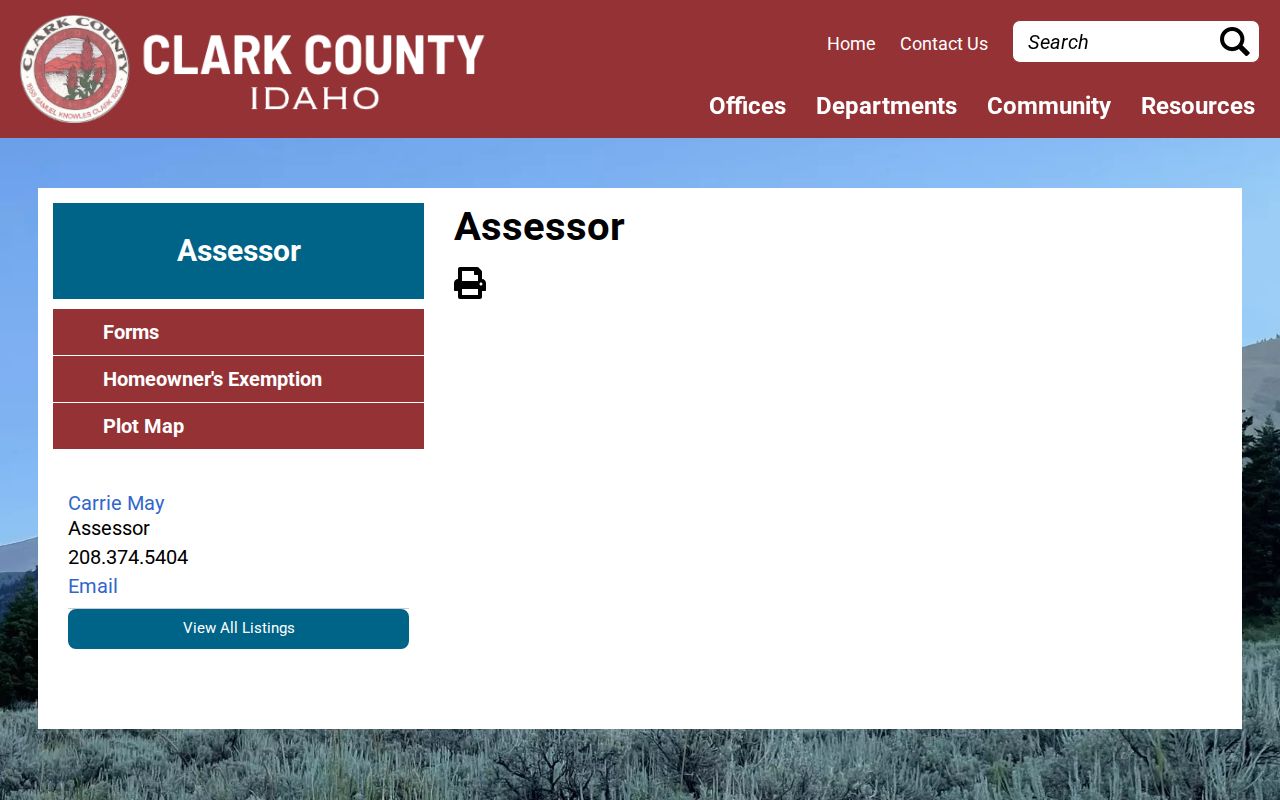
The image shows the county office and its GIS links. The missing live assessment card is one more reason to confirm the exact field you need directly with the Assessor.
Look Up an Assessed Clark County Property Value
Begin with a reliable parcel match. Then inspect the value record tied to that parcel. Clark County's online map serves better as an identity and location tool than as a confirmed assessment-card display.
- Use the county-linked Greenwood map to identify the address and copy the full Parcel field.
- Confirm St Addr and Location so a mailing address does not cause a false match.
- Obtain the current assessment card or notice from the Clark County Assessor.
- Record each field label, amount, exemption, and value year exactly as supplied.
- If sale price matters, compare a recorded transfer rather than assuming it from the assessment.
- Assessed value
- The assessor's official valuation conclusion for the assessment process.
- Market value
- The value standard Idaho directs county assessors to estimate.
- Assessment level
- The relationship of assessment to market value, set at full value in Idaho.
- Consideration or sale price
- A transfer figure from transaction evidence, when shown and meaningful.
- Reassessment
- A new value determination based on the applicable cycle or changed facts.
How Clark County Property Value Evidence Is Built
An assessor does not price each parcel by copying its last deed. Idaho guidance points to sales and property characteristics instead. Location, size, age, quality, condition, land, and improvements can all shape the mass-appraisal result. Ask what facts the Assessor used. Ask whether the record describes the subject parcel correctly.
When the full card is available, check for separate land, improvement, and total fields, plus the value year and exemption flags. Greenwood's GIS results do not publish those fields. Their absence does not mean the Assessor lacks them. It means the GIS ownership layer is not the complete valuation record.
Relief Programs Change Clark County Taxable Value
Idaho's homeowner exemption, Idaho Code §63-602G, and the Property Tax Reduction program can change the taxable result without touching the market evidence. The Clark County homeowner exemption page routes residents to local information. Current state guidance explains eligibility and filing.
The distinction matters when two records show different totals. One may reflect assessed market value before relief. Another may show the base after an exemption or reduction. The gap does not prove a reappraisal or a sale. Each stage answers a different question. It may simply compare stages of the tax calculation.
Note: Use the Clark County property tax records guide for bills, installments, exemptions, and assessment appeals.
A Sale Price Is Not Clark County Property Value
A deed can offer a transaction clue. Clark County offers no online recorder search with a modern index. The Clark County recording page is the official contact route for a current instrument. Ask for the deed by party name, parcel or legal description, and approximate recording date.
Even a stated consideration amount needs context. A transfer may include several parcels, reserved rights, family terms, or estate administration. It may also predate the current assessment. Treat the sale figure as evidence of that one transaction, not an automatic answer to present property value.
Clark County Property Value Records Need a Date Check
Valuation numbers in Clark County answer to a calendar. Assessment notices go out, and Idaho's county boards of equalization hold their key statewide session on the fourth Monday in June. A value displayed online may still lag behind a sale, a correction, an improvement, or a relief decision that has not yet worked its way in. Check the date before trusting the figure.
The county advertises daily updates to its ownership shapefile. That promise covers the download only. It says nothing about which assessment year a value belongs to, and nothing about the Clerk/Recorder's lag between a recorded deed and the assessor's tax roll. A fresh GIS map label and a stale assessed value can sit side by side, because the two sources serve different county functions and refresh on different clocks.
Request Missing Clark County Property Value Fields
When the online layer is too thin, contact Assessor Carrie May at 208-374-5404 or write to the office at 224 W Main St, PO Box 7, Dubois, ID 83423. Name the parcel, owner, situs, and desired value year. List the exact fields needed, whether land, improvements, total assessed value, exemption status, or value history, so the clerk can pull the record in one pass.
The Idaho Public Records Act guidance explains request timing and fees. Idaho residents get the first two hours or 100 pages free, with actual-cost rules after that threshold. A narrow request for one parcel and one value year is far more likely to draw a direct answer than a broad demand for every assessment record the office holds.
What Clark County Property Value Records Cannot Promise
An assessed value is not a promise. It will not guarantee a sale price, a lender's appraisal, or a replacement-cost figure. It will not promise an exact tax bill either. It rests on its own date and evidence. That evidence may differ from any private valuation. A GIS acreage or tax-area label adds context, but it does not create an appraisal. For a purchase, a sale, an estate, or a boundary-sensitive call, match the parcel first. Then bring in the right professional.
Value is not price. A Clark County assessed value serves tax administration. It is not a promise of what the property would sell for and is not a private appraisal.