
A Backward Timeline for Clark County Former Owners
Clark County's online historical sources cover different time spans. Some deed indexes reach further back than others. The table below shows where a backward chain of former owners can move next, without treating a collection title as proof of what a current county portal holds.
| Source | Years It Covers | Where Held | What It Shows |
|---|---|---|---|
| Latest recorded conveyance | Current cutoff not published | Clark County Clerk/Recorder | Current grantee, prior grantor, vesting, and legal description |
| Grantor deed index | 1907 to 1998 | FamilySearch collection from Clerk originals | Transfers indexed under the party conveying an interest |
| Grantee deed index | 1906 to 1950 | FamilySearch | Transfers indexed under the party receiving an interest |
| Deed images | 1911 to 1960 | FamilySearch digitized records | Instrument wording and legal-description evidence where images are accessible |
| Patents and mining locations | 1890 to 1997; 1884 to 1935 | FamilySearch | Earlier land and mineral-interest leads |
Always start at the newest recorded deed, even when the goal is much older owners. That anchor keeps the Clark County deed chain tied to one parcel. A historical name with no link to the current parcel may belong to a different tract or to an interest that never entered this chain at all.
Reading a Clark County Deed Chain Backward
The method reverses one transfer at a time, and the legal description serves as the control throughout the Clark County deed chain.
- Identify today's parcel in Greenwood and obtain its newest recorded deed from the Clerk.
- Read the current owner as grantee and the former owner as grantor.
- Search that former owner in the grantee index to find the deed by which the person or entity acquired the same land.
- Compare book/page or instrument reference, date, acreage, lot and block, subdivision, and section-township-range calls.
- Repeat with the next prior grantor, moving to books, archives, patents, or predecessor counties when the verified runs end.
- Grantor / grantee
- The conveying party and the receiving party.
- Chain of title
- The linked sequence of recorded transfers affecting the same land.
- Reverse index
- An index organized by the grantor side of a transfer.
- Warranty / quitclaim
- A warranty deed includes covenants; a quitclaim passes only the interest claimed.
Clark County Legal Descriptions Keep the Chain on Track
Names alone make weak historical identifiers. Initials shift. Married names, estates, trustees, and businesses can all vary across Clark County deed entries. At every transfer, copy the land description and the prior-instrument reference. That pairing is what proves the link. A change in acreage or lot label may signal a split, merger, or correction. It could also mean a neighboring tract slipping into the chain.
Inside Dubois or Spencer, the subdivision, lot, and block often provide the stable bridge between eras. Rural deeds lean on metes and bounds or Public Land Survey calls instead. A modern parcel number may change mid-chain. Find the recorded plat, lot-line adjustment, vacation, or correction that explains it before moving on.
Probate Links Among Clark County Previous Owners
A death can interrupt the tidy buyer-and-seller pattern of a deed chain. Clark County's historical collections include probate estate loose papers from 1903 to 1950. Letters testamentary run from 1901 to 1961, and wills from 1909 to 1963. Those records can identify authority or heirs. Still, match the recorded estate instrument to the parcel. Do not treat it as part of the chain before that.
Watch for executor, administrator, trustee, or beneficiary capacity in the documents. A personal-representative deed can connect the court's authority to the next owner. A will by itself does not prove every later recording step actually occurred.
Former Clark County Owners Before the County Existed
Clark County was created on February 1, 1919. Records for the same land before that date may sit under Altumas, Oneida, Bingham, or Fremont counties. Boundaries shifted over time. That jurisdiction trap explains why a failed Clark County index search does not mean the record is missing. The record may simply live in a parent county.
Note the county name each source uses and the span it governed the area. Railroad-era place names like Beaver Canyon, Dry Creek, Beaver, Dubois, and Spencer can sharpen a Clark County property search too. Even so, a place-name match must still tie back to the legal description. Only then does it earn a place in the chain.
The 1921 Dubois Map as a Former-Owner Clue
The University of Idaho's 1921 Dubois Sanborn map can connect an old building footprint or street context to later parcel research. It works best for forming a hypothesis. This is especially true where Clark County addresses changed over time.
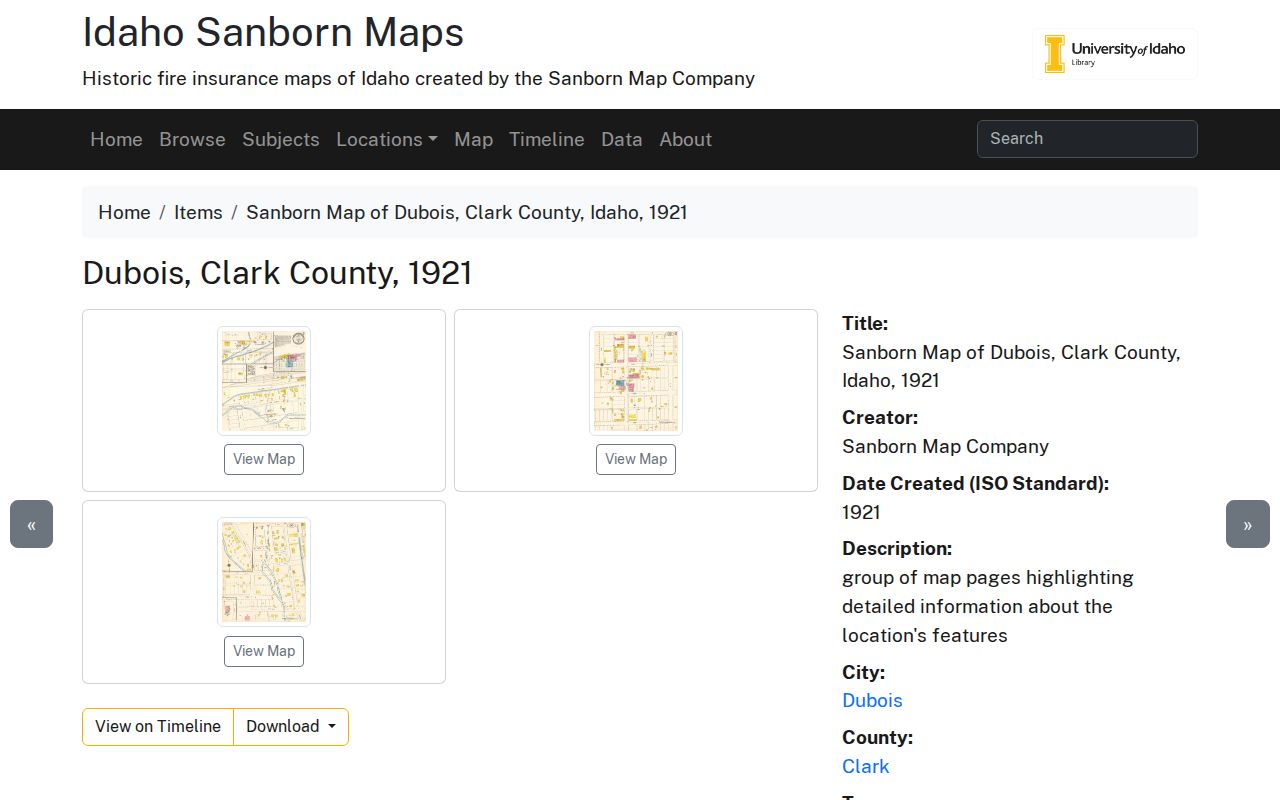
The map does not establish title. Pair it with deeds, plats, tax records, or probate material, and note that the library directory resource directs Spencer researchers to "See Dubois."
How Far Back Clark County Former-Owner Records Go
The FamilySearch grantee index begins in 1906, the grantor index in 1907, and deed images cover 1911 through 1960. Those dates belong to specific Clark County collections. They say nothing about the current Recorder index cutoff, and they do not prove every older book is online.
Online cutoff caution. When the digitized run ends, ask the Clerk about deed books and images, then check the Idaho State Archives and relevant land-patent sources.
Mining locations predate the deed indexes, and patents can extend a rural property story. Neither belongs in a chain until the land and interest match, though. The county records show no courthouse fire or record-loss event, so do not explain a gap by inventing one.
Lawful use. Trace former owners for house history, title research, or property diligence. Never use historical owner information to track, harass, threaten, or harm a living person.
Need a copy of one instrument? The Clark County deed-record guide walks through that step. A full title conclusion, though, may call for a professional examination that goes beyond the documents themselves.
A finished chain should list one row per transfer: the recording date, grantor to grantee, deed type, and book/page or instrument number. Record execution and recording dates separately, and keep alternate spellings intact. Note any shift in acreage or land description. Mark gaps honestly rather than smoothing them over. That paper trail shows exactly where an offline book, predecessor-county index, or probate file is still needed, and anyone can follow it again from the start.
Distinguish an ownership transfer from an encumbrance or release, too. Mortgages, deeds of trust, assignments, reconveyances, liens, and easements all matter to a full title study, yet they do not each create a new former owner. Keep them in the chronology as related events without turning every named party into a landowner. A lender, trustee, beneficiary, or easement holder should never appear in the chain as if it held title.
Other record groups help explain a rural chain. Clark County mining locations span 1884 through 1935, patents span 1890 through 1997, and a brand record book covers 1937 through 1955. Treat these as context, not as substitutes for recorded conveyances. Match the land description and the nature of the interest before tying a name to prior ownership.
Give names their own audit. Search initials and full given names, married-name variants, alternate spellings, trust and company wording, and fiduciary capacities. A same-name hit becomes persuasive only when the legal description, acreage, date sequence, and prior reference all fit. If a deed points to a different lot, section, or acreage, stop and resolve the parcel change rather than forcing the person into the timeline.
Older Clark County work can cross record systems as well. A historical map or directory may suggest that a building or person occupied a place, and the federal census is open through 1950 under the 72-year release rule. Neither proves title. Use those clues to locate a deed, probate file, patent, or tax record, and label the county jurisdiction that applied when the source was created.
For an offline request, state the exact former owner name, the approximate year, the transfer direction, the legal description, and any known book/page. Ask whether the item is an index entry, deed-book image, original instrument, plat, or archive holding. The Clerk publishes no stated policy on image requests, certified-copy fees, older shelf lists, or the modern online cutoff, so confirm those details directly rather than relying on FamilySearch.
At the end of the search, separate confirmed transfers from leads. A confirmed row carries a record reference and a matching land description. A probable row may hold the right names and date but still lack the image. A map, directory, census, or brand-book clue stays contextual until a land record connects it. Grading the results this way is more honest than presenting an unbroken narrative where the trail has gaps.
If the chain reaches an original patent, record the patent source and description, then continue forward through county instruments. A patent marks an early land-interest event, but it does not explain every later division, inheritance, easement, mortgage, or sale. Mining-location material deserves the same caution, since it may concern a distinct mineral interest rather than full surface ownership.