
Clark County Deed Types
Deed records in Clark County hold more than sales. The Clerk/Recorder files conveyances alongside mortgages, easements, and corrections, each with a different legal effect. A mortgage secures a debt. An easement only shapes access or use, while a correction deed repairs text without creating a new sale.
| Deed Type | What It Does | Common Use |
|---|---|---|
| Warranty deed | Conveys land with stated covenants | Ordinary purchase or sale |
| Quitclaim deed | Transfers the interest the grantor claims | Family, estate, correction, or boundary cleanup |
| Personal-representative deed | Connects estate authority with a transfer | Probate administration |
| Correction or re-recorded deed | Revises a name, description, or clerical point | Fixing an earlier instrument |
| Deed of trust or mortgage | Creates a security interest rather than a sale | Secured financing |
Read the full instrument before drawing conclusions. Consideration, return addresses, covenants, and the depth of legal-description detail all vary by filing, and the office publishes no current list of its online document-type choices.
Clark Recorder Access Route
The official Clark County Clerk page is the entry point for recording work. Its recording page posts no live index. No search fields, coverage cutoffs, image rules, or fees appear there either. A direct request beats guessing. Give the Clerk a grantor or grantee name. Add an approximate recording date. Include the parcel number and each legal-description clue you hold. Ask for the instrument number or book and page first. Confirm the current charge and delivery method for a certified copy. No fee appears on the county pages. The recording page itself displays the county's instructions for submitting a document. That office stays the authority.
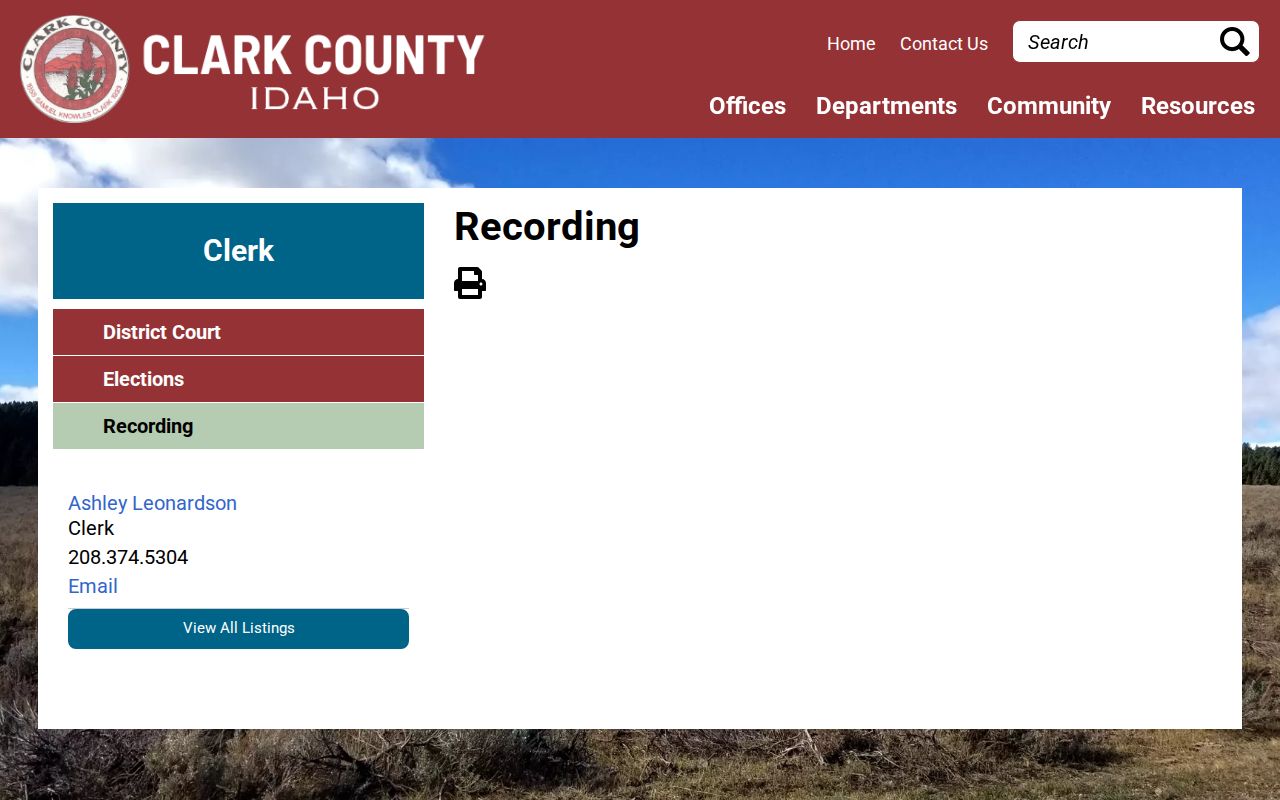
The capture does not establish a searchable current deed database or any fee.
Historical Clark Deed Depth
The best historical route is the free FamilySearch Clark County collection. It draws originals from the Clerk's Office. Its indexes include a grantee list for 1906 through 1950 and a grantor list for 1907 through 1998, with deed images covering 1911 through 1960. Mining, patent, and probate groups explain unusual transfers.
| Collection | Verified Years | Title Research Use |
|---|---|---|
| Grantee deed index | 1906 to 1950 | Find when a named party received land |
| Grantor deed index | 1907 to 1998 | Find when a named party conveyed land |
| Deed images | 1911 to 1960 | Inspect instrument text where access permits |
| Mining locations | 1884 to 1935 | Trace historic mineral-interest clues |
| Patents | 1890 to 1997 | Connect the chain with an early patent |
Those dates describe the collection, not a county cutoff. Sign-in rules or image limits may apply. The Clerk can answer for later deed records and any earlier physical volumes.
An index and an image answer different questions. An index entry is only a locator. It may give names, a recording date, and a book or instrument reference while omitting covenants, exceptions, signatures, and the full legal description. The deed image holds the recorded text and attachments. Check those before tying the entry to one tract. When image access is restricted, copy the citation and ask the Clerk to retrieve the matching page.
FamilySearch describes the whole Clark County collection as spanning 1884 through 1998 with 19,976 images. Not all of those images are deeds. Mining, patent, probate, guardianship, will, and other county material sits in the same collection. Filter by record group and year first. A grantor index reaching 1998 still does not prove every modern deed image is viewable online.
Clark Grantor-Grantee Trail
A chain of title is rebuilt transfer by transfer. No bare owner list will do it. Start from the latest confirmed deed and read who received the land, who conveyed it, and how the tract was described. Then use the prior owner's name to find that person's acquiring instrument at the Clerk/Recorder.
- Start with the current Greenwood parcel and obtain the latest deed from the Clerk.
- Record grantee, grantor, dates, recording reference, and full legal description.
- Search the prior grantor as an earlier grantee, allowing for initials, married names, trusts, estates, and entities.
- Compare lot, block, subdivision, acreage, and section-township-range language before accepting the match.
- Repeat, then move to the Clerk, catalog images, archives, or patent records when web coverage ends.
- Grantor
- The person or entity conveying the stated interest.
- Grantee
- The person or entity receiving the stated interest.
- Chain of title
- The linked sequence of instruments affecting the same land.
- Book and page
- A volume-and-page locator for a recorded document.
- Instrument number
- A recording identifier assigned to one filing.
Clark Legal Description Checks
In Clark County deed records, names alone prove little. One party may own several tracts. Another person may share the name. At every step compare lot and block, subdivision, acreage, metes-and-bounds calls, and section-township-range text, plus any prior-instrument reference in the deed.
A changed acreage or lot label can mark a split, merger, correction, vacation, or boundary adjustment. Keep both parcel numbers if the GIS key changed. Then request the recorded plat, survey, or lot-line instrument that links the old tract with the new one. Clark County's parcel map resource can orient the check, but recorded documents carry the legal evidence. Maps guide; deeds prove.
Note: Compare execution and recording dates, because they answer different questions about when a Clark County transfer occurred.
Lot-and-block text points to a recorded plat. Metes-and-bounds text follows bearings, distances, monuments, and calls around the tract. Public Land Survey references use section, township, and range. These forms can overlap within a single chain. Transcribe the description instead of paraphrasing it, since one changed lot number, directional call, or exception clause may identify entirely different land.
Clark Liens and Releases
A full deed records search in Clark County covers more than conveyances. It also follows the filings that burden or clear a parcel. Look for deeds of trust, mortgages, assignments, reconveyances, releases, and satisfactions. Liens, judgments, lis pendens notices, easements, rights-of-way, and tax-lien notices belong in the same sweep. Each one can mark or lift a claim.
Match every release back to the original security instrument. The recording reference and the legal description should line up. A mortgage is not an ownership transfer. Do not assume a lien is gone on its own. The matching release or satisfaction must be on file. An odd recorder entry sometimes traces to a court order or probate paper.
A lis pendens is different. It records notice that litigation may affect the land, not the final ruling. Quiet-title, partition, foreclosure, and probate matters start in court. They may end with an order or deed at the recorder. Clark County sits in Idaho's Seventh Judicial District. The statewide iCourt portal is the public entry point for case searches. Sealed or exempt material will not appear there. Before adding a court hit to the deed chain, check the parties and case number. Match both against the parcel's legal description.
Pre-1919 Clark Land Records
Clark County was created on February 1, 1919. Older chains of title do not stop at that line. A search reaching farther back may pass through Fremont, Bingham, Oneida, or Alturas County records. That jurisdiction shift can sink an index search while the land trail continues.
Keep the legal description stable while testing predecessor-county indexes, patents, and archive holdings. The Idaho State Archives offers county, city, court, and genealogy research services. No Clark deed-book shelf list is published there. Mining-location records and federal patents can also bridge an early rural chain.
FamilySearch groups Clark County probate materials too. Estate papers, letters testamentary, wills, and guardianship files can explain a transfer. An executor, administrator, trustee, or heir may appear there for a reason. These papers are aids, not a substitute for the deed itself. Compare the probate authority with the recorded instrument. Confirm both describe the same land.
Note: A pre-1919 land search may need a predecessor county. It held the same ground on the transfer date.
Request a Clark Deed Copy
Ask for a specific record whenever you can. Supply indexed names, an approximate date, the document type, and the parcel or legal description. Add the instrument number or book and page. State whether the copy is plain or certified. Clark County publishes no current fee or image-delivery rules, so confirm both before paying.
A deed missing from a public interface has another route. An Idaho Public Records Act request can identify the custodian, the subject, and the date range. State guidance gives Idaho residents the first two hours or 100 pages without a fee, while larger work can carry actual costs. Response periods differ for residents and nonresidents. Do not expect instant production either way.
Recording is not a title opinion. A filed Clark County deed may be key evidence, but the recorder does not resolve priority, hidden claims, or boundary disputes.
Start with the first deed. From there, use the former property owners workflow. Fit the copy type to the task. A plain copy supports personal research and helps identify the next instrument in the chain. A certified copy carries the recorder's certification. Formal processes may require it. Ask the receiving office, court, or professional what it needs before paying for certification. Clark County publishes no electronic-delivery rules, turnaround time, or current per-page price.
An incomplete citation needs more than a surname. Add the other indexed party, the narrowest year span, the document family, and the parcel's legal-description terms. That trims false matches and helps staff tell a deed from a mortgage, release, easement, or probate instrument recorded near the same date.